
It is often said of art that it “should comfort the disturbed and disturb the comfortable.” Well, the same can be said of these questions that we have today from Oliver Burkeman. They are taken from the end of his book Four Thousand Weeks. A great book about time and how we use it. You can find my review of this book here.

It’s no secret the way that this topic of time can engender great fear in us, but, rather awkwardly, there is also a healthy fear to be found in the contemplation of our finitude which we need to embrace.
So, in this spirit, I’m glad to present Oliver’s curious questions to you, confident that they will be productive for whatever stage you’re in.
He shares these five questions saying that “to ask them with any sincerity is already to have begun to come to grips with the reality of your situation and to start to make the most of your finite time.”
I’ve tried to include a short reflection on my own journey for each.
1. Where in your life or your work are you currently pursuing comfort, when what’s called for is a little discomfort?
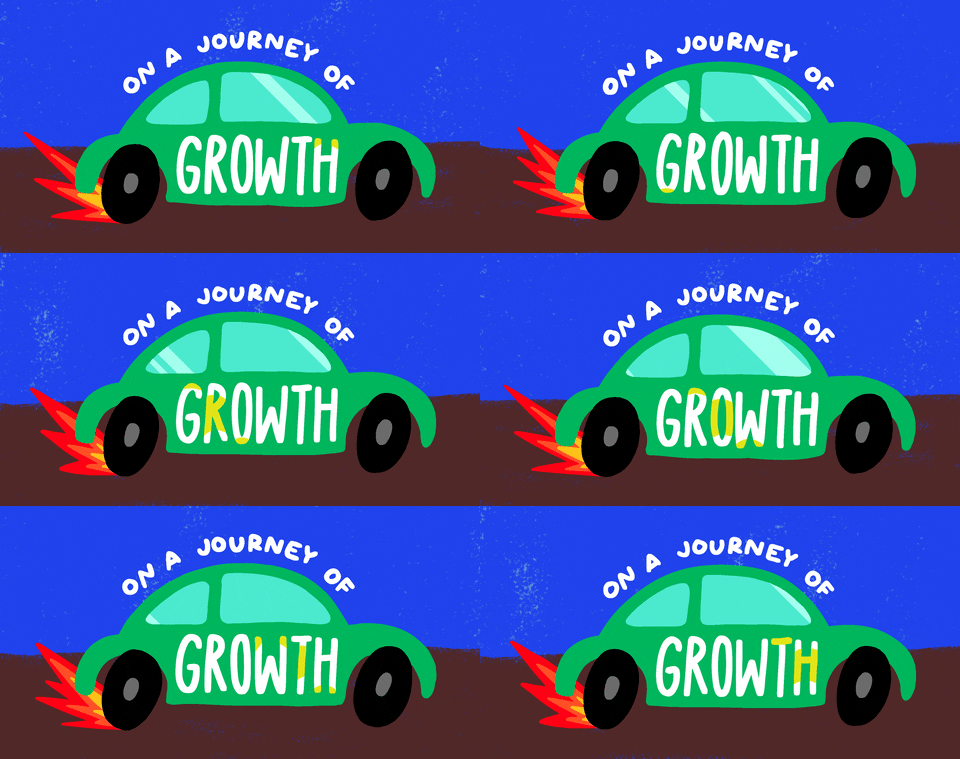
If you look for truth, you may find comfort in the end; if you look for comfort you will not get either comfort or truth only soft soap and wishful thinking to begin, and in the end, despair.
— C.S.Lewis
Our calling is always going to lead us in the direction of the unknown. To something that draws new things out of us and calls us to learn and grow. But the key is to know what season we’re in. We know instinctively how much we are being stretched, or whether we’ve been coasting for too long and letting our gifts go to waste.
This question is a great decider question. It’s the kind of question I would ask myself when I’m feeling stuck between two options. Either two great options, or two equally bad ones.
Oliver says you should “choose uncomfortable enlargement rather than comfortable diminishment whenever you can.”
This lesson became particularly clear to me once, when playing a computer game. (See mum, they’re NOT a waste of time!) I realised that when playing games I always want to keep on the edge of my abilities, taking risks and expanding experience points, in order to progress through the game as quickly as possible.
Why do I not have the same attitude toward life? Is it simply fear? During the game, I expect to make mistakes, venture into new areas and try on new ways of being all the time, that’s how I know I’m doing well.
The moment you gain a new skill or opportunity in a game, you exploit it.
What season are you in? Is it time to stretch yourself?
2. Are you holding yourself to, and judging yourself by, standards of productivity or performance that are impossible to meet?

If you were your own boss, would you quit?
Sometimes we drive ourselves to try to achieve things which we would never do to others.
When we find a passion, a vision, a calling to follow; we find that we want to give everything to it. And the way we pursue this passion can make all the normal boundaries a bit blurry.
Maybe we’ll work through lunch because we simply forgot to eat.
Maybe the boundaries between work life, home life and rest start to become more hazy than we’d like.
Whatever it is, it’s good to keep our vocation in perspective.
It’s because we don’t want to give up the vision that we find it hard to set reasonable boundaries for how we use our time. The way to beat it is to get real and get creative. Design for yourself a genuinely exciting and enjoyable way of working toward what you love.
The best way to use our finite time is by keeping this wholistic picture in view.
I know, for myself, I only end up getting sucked into working those extra hours when the work is enjoyable, because I’m so excited to jump into the work that I don’t really stop to think about the end point at the beginning. In my work at Fiasco this is called “time-boxing”. It’s way easier to time-box work that is difficult or a slog, but I realise now that it’s just as important to set reasonable limits for work that I love too.
“I have a theory that burnout is about resentment. And you beat it by knowing what it is you’re giving up that makes you resentful.”
—Marissa Mayer
3. In what ways have you yet to accept the fact that you are who you are, not the person you think you ought to be?
Are you using your time avoiding who you are? Treating present life as only valuable when you become who you should be?
What Oliver is getting at here, is that we can find ourselves in a sneaky little life loop. It’s a very bad vibe. It’s where we postpone our enjoyment of the present until we become a version of ourselves who we think deserves it. We earn our permission to relax through work. We earn enjoyment. We earn ourselves toward accepting praise and encouragement. Fun comes after work. Love comes after achievement. Dessert comes after vegetables.
It’s like dessert comes after vegetables, so I’ll wolf down this meal so I can get to dessert.
But why not enjoy the whole meal, idiot?
Hmm, for me, this one is a little hard to grasp hold of for some reason. Maybe it’s something that I’m yet to learn properly.
What I do know is that until we are able to acknowledge ourselves for who we are in the here and now, we will waste our lives on a fiction.
We will pursue goals that are not for us. Build and bully ourselves through a life that is designed for a more perfect version of ourselves who we are going to become later. And we’ll postpone our enjoyment of that life, until we have become that person we’re imagining.
We’ll be lost in the future, saying “life will be lovable when…” {fill in the blank here}
I think we all know that feeling of looking back on old versions of ourself with embarassment. Did I really sound like that? Was my work really that basic? Oh no. I know this feeling well.
What we forget is that this was the best we could do at the time. There was no other way to become who you are now. The problem is if we take the wrong lesson from this and accidentally project this idea into the future as well. We become perfectionists, perpetually embarrassed of who I was even a few weeks ago.
4. In which areas of life are you still holding back until you feel like you know what you’re doing?
The feeling of total authority is never going to arrive, so why not throw yourself in?
This question is not for the Elizabeth Holmes’ of the world. This is for those of us normal people who find the balance between healthy caution and full-blown paralysation a slippery one.
I think we all find ourselves being held back at times, without ever really consciously choosing it.
It’s those pesky little fears, and limiting beliefs we have about ourselves that jump in the driving seat from time to time without us even realising.
I think this question is a great one to return to from time to time in all areas of life; just to help us recognise when we’re being held back from doing what we need to:
“I’ll apply to that role when I have more experience” quickly becomes “…when I feel more confident that I’ll get it”.
“We’ll have kids when we’re ready” soon becomes “…when I’ve got my affairs in order.”
“I’ll have that tricky conversation when the time is right” soon becomes “…when I can ensure I won’t offend them.”
If this kind of reason-creep goes on unchecked, it becomes indefinite. And then there’s no limit to how much they will hold us back and waste our time. I shudder to think.
This is why it’s especially good to return to: “In which areas of life are you still holding back until you feel like you know what you’re doing?”
5. How would you spend your days differently if you didn’t care so much about seeing your actions reach fruition?
In a recent interview with UnHerd, John Vervaeke encouraged people searching for meaning to ask this question:
“What do I want to exist even if I don’t and how much of a difference do I make to that now?”
This sets a radically different perspective where we can help clarify what is worth spending our time on, even if it’s not something that we achieve ourselves.
All of mankind’s greatest, lasting and worthwhile achievements are literally impossible to achieve as an individual. Cathedrals are not built by a single bricklayer. Children are raised by a neighbourhood. Yet, just to be a part of these things is a great privilege and blessing.
I find this question really helpful for changing my frame and thinking about my vocation as a small contribution to a particular vision of the world, rather than a task to complete. And it reminds me that the rewards of following our calling are in the here and now; not because we find satisfaction in the completion, but through knowing we’re in the right place, spending our lives on beautiful investments.
Godspeed,
TMo