
Ikigai has become a pretty popular idea in the last few years. Helped most of all by a few TED talks, books and blog posts that seemed to ride the wave of Japanese cultural coolness which hit the UK and the US in the 2010s.
Originally a Japanese concept, ikigai is often described as something like “your reason for being” or “your reason to get out of bed in the morning”.
But, as you’ll soon see, and as I have discovered in my research, nothing is quite as it seems when it comes to the world of ikigai and how it came to the West. And I want to walk you through my thinking here so you can get an idea of why there’s a bit of a problem with ikigai.
But first! What is it?
Well, I first came across the concept in Rob Bell’s excellent book How To Be Here:
“To be here is to embrace the spiritual challenge of your ikigai, doing the hard work of figuring out who you are and what you have to give the world.”
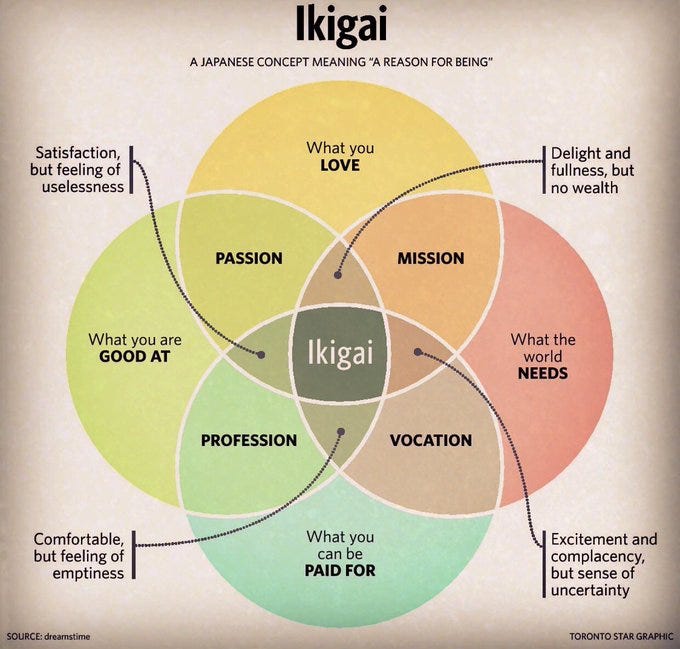
Then later I came across it in the form that many of you will be familiar with: Four concentric circles overlapping in a Venn Diagram where each circle is named “what you love”, “what the world needs”, “what can make money” and “what you are good at”.
And in the middle of this diagram is your goal: ikigai!
I fell in love with the simplicity and Bird’s Eye view perspective it builds.
I was in a branding workshop which used the diagram as a group exercise for helping us to discover common goals. It was really clarifying and straightforward.
Of course, I could see some limitations and simplifications with the diagram, but for me, it was a win! In my years of research trying to discover how to help people find their calling, this registered as the first non-western tool that I had come across.
Classically though, things started to get a bit more complicated when I began to look into ikigai for myself.
With ikigai though, even the first squeeze revealed that this famous diagram which I had fallen in love with is something of a misnomer. It was originally created in 2011 by Spanish author and psychological astrologer Andres Zuzunaga, and was later adapted in a hugely successful blog post by Marc Winn, who replaced the word “purpose” with “ikigai”. I started to realise that this diagram is a very heavily interpreted version of ikigai.
So much so that it calls into question whether it can really be called the same thing. If you’re interested, this blog post outlines some more of this story.
Next I came across the writing of Ken Mogi, a native Japanese speaker and author of several books on ikigai who tried to rectify the problem by outlining the differences between the traditional understanding of ikigai and this modern, western interpretation:
“this diagram is very strange, to say the least, because, I'm saying that this is useful. Of course, for the western readership, probably this diagram is useful in structuring what motivates you and what gives you pleasure, and so on. But this diagram is very strange because it defines ikigai as the intersection of all these things, what you love, what the world needs and what you can be paid for, and what you are good at, and ikigai is defined as the intersection of all these things.
That would be great if you can do something that satisfies all these requirements. But that is too narrow of a definition for ikigai. Because if you believe in this diagram, then what you love, but for what you cannot be paid for, for example, your hobby, is not ikigai, right? That's really rubbish. Maybe I shouldn't have said that word. But I would say again, it's rubbish.”
It seems like he wanted to set the record straight and provide an authentic fuller definition of the tradition.
From what I understand, the traditional concept is much more loose. It’s more of an idea than a tool. Just like our western understanding of ‘calling’ or ‘vocation’.
Anne-Laure Le Cunff puts it this way:
“What makes it such a powerful idea in today’s age of constant change and uncertainty is that ikigai doesn’t limit someone’s value in life to career and financial status. In fact, in a survey of 2,000 Japanese people conducted by Central Research Services, only a third of respondents considered work as their ikigai.
Rather, ikigai is about feeling your life makes a difference in people’s lives — the idea that you can contribute to other people’s lives simply by living a fulfilling life. And this idea can unlock many benefits.”
So, none of this is a problem until I realised that the westernised version is popular for a reason. It works. It’s simple. It took the traditional, somewhat hairy concept and, after giving it a trim and putting it in a suit, it sent it off to work as a tool. And when it comes to the actual term, it doesn’t seem to have much more to offer us than what we already have in our language already through words like ‘calling’, ‘purpose’ or in French, ‘raison d’être’.
Notice how Ken Mogi’s description here makes this explicit:
“As a Japanese, of course, I have been exposed to this concept of ikigai over many, many years. And I have been discussing ikigai in daily lives in a casual manner: that ikigai is something that is common in the Japanese culture …as I wrote in the book…we do not actually think so explicitly about ikigai because it's like the air we breathe. In Japan, we are aware of this concept of ikigai from childhood. And we don't actually discuss ikigai in expressed, rule-based, algorithmic ways.”
He goes on to say:
“Although I am thankful for anybody who has conceived of this diagram. I think it was, well, a job well done. But it's something that can also be misinformation or disinformation even for people who are interested in ikigai.”
This made clear to me that ikigai is more of a loose concept than a tool, and is not much—if at all—different from our idea of calling or raison d’être in daily use. If this is the case, then it raises the question of why would we use the Japanese term instead of others which are already known and somewhat more native to our culture? I can think of two reasons why we might:
The first is that it is cooler. It’s cooler because it sounds more exotic, and because all things Japanese are trendy right now.
Secondly, I think that ikigai might benefit from a kind of outsider effect where people are predisposed to receive new and unfamiliar ideas with a more open mind than things they have heard of before. This could possibly have more of an impact than the use of familiar ideas. This is the classsic “no prophet is accepted in his hometown” effect.
These are interesting reasons, but I don’t think that they are entirely convincing to me. And they don’t fully tell us what to do about the westernised version of ikigai. I’m left feeling a bit ambivalent, but ultimately slightly leaning towards the idea of rediscovering and mining our own concept of calling, moreso than trying to go all-in on adopting the ikigai worldview which, let’s face it, would be a tall order.
And then, what off the Westernised understanding of Ikigai? Is it authentic? Umm, nope! But is it useful? I think so. Certainly, as a short exercise it can be a really helpful tool and so we should embrace it. But we would also do well to acknowledge the differences, lest we cheapen and obscure the very real and living cultural heritage from which it comes and the whole way of looking at life which it refers to.
Would you like to hear more about ikigai? Let me know in the comments and then I can get a sense of whether you’d like to see a book review on the idea.
Godspeed,
T Mo